
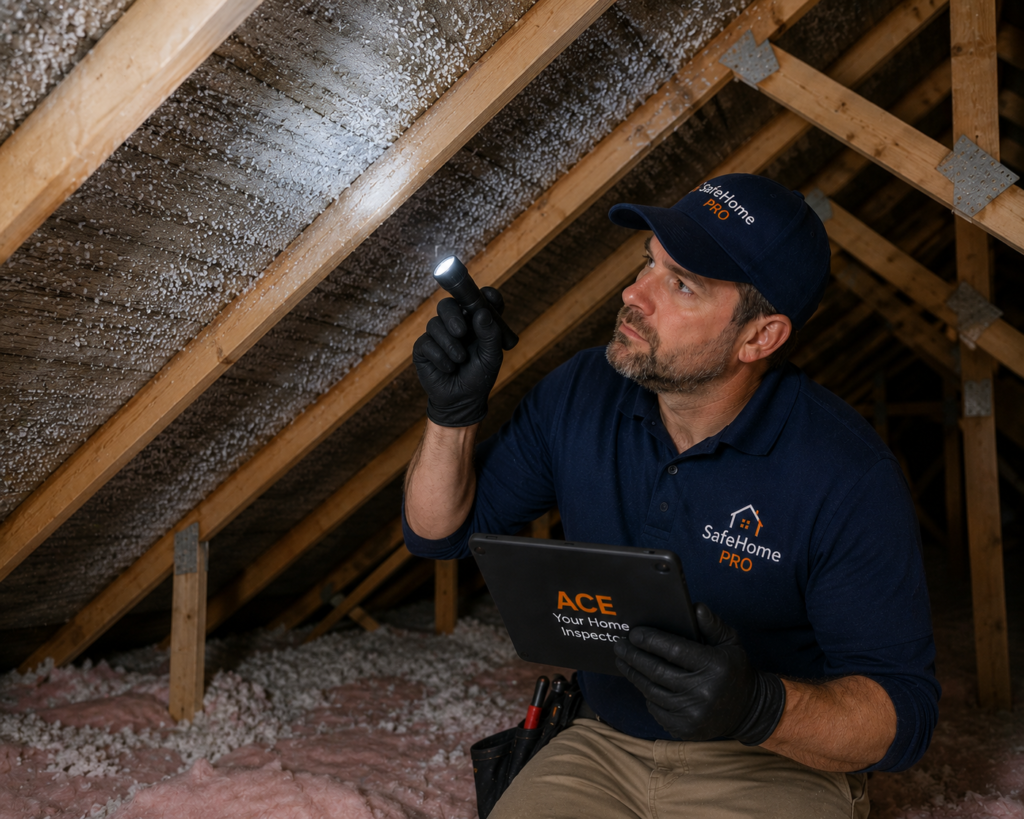
Attic Moisture Signs: What Homeowners Should Look For Before Calling a Roofer
Attic moisture signs often appear long before any ceiling stain shows up below — if you know what to look for. This guide walks homeowners through what a healthy attic looks like, what attic moisture actually looks like, and the practical 15-minute self-check that separates “normal” from “needs attention.”
Why Attic Moisture Is Easy to Miss and Expensive to Ignore
Most attics are visited once or twice a year, if that — and most homeowners assume problems up there will eventually show themselves below as ceiling stains. They do, but by the time they do, framing has often been wet for months. Attic moisture is one of the slowest-moving home problems, which is exactly why catching it early pays off so heavily.
Two upstream sources dominate. The first is a true roof leak — flashing, vent boots, missing shingles — which deposits water in localized areas. The second, and more common in modern homes, is condensation: warm humid air from the living space leaking up into a cold attic and condensing on the underside of the roof deck. Both leave visible attic moisture signs. The fixes are completely different.
Seeing something off in your attic?
Describe the sheathing color, frost or rust patterns, and insulation condition — ACE will help you tell normal from concerning.
What a Dry, Healthy Attic Looks Like
Knowing what “normal” looks like makes the abnormal patterns obvious.
- Roof deck is clean wood — uniform color, no dark blotches, no salt-like deposits.
- Rafters and trusses look dry and uniform.
- Insulation is loose, fluffy, and uniformly distributed across the floor.
- Soffit vents are visible and unblocked at the perimeter.
- A ridge vent or roof vents at the upper end of the attic provide the second half of the airflow path.
- Bath fans, dryer, kitchen exhausts terminate outside the attic, with rigid or insulated ducting.
- No frost on roof nails in winter.
- Air feels dry and cool in summer, cold but dry in winter.
The Attic Moisture Signs That Matter
Darkened or stained roof deck
Look at the underside of the roof sheathing with a flashlight. Localized dark patches under a single penetration usually mean a roof leak. Broad, diffuse darkening across a wide area, especially the north slope, usually means condensation.
Frost or beads of moisture on roof nails
In winter, look at the tips of the nails poking through the deck. Frost or visible water on the metal is one of the clearest condensation signals you can find — almost diagnostic on its own.
Wet, matted, or compressed insulation
Healthy insulation is loose. Wet insulation looks pressed-down, matted, and discolored. A localized wet ring usually means a leak directly above. A broad area of compressed, slightly damp insulation usually means humid air rising from below has been condensing.
Mold or mildew on sheathing
Black, gray, or greenish patches on the underside of the deck are biological growth. Light surface growth can sometimes be cleaned; widespread or recurrent growth is a remediation conversation.
Rust on fasteners, fan housings, or metal flashings
Sustained moisture corrodes metal. Rust streaks on the deck below a nail head, rusted bath-fan housings inside the attic, or rust at metal vent flashings all indicate a moist environment.
A musty or damp smell
Attic air should smell like wood and dust. A musty or sweet-damp smell points to sustained moisture even if you can’t see anything obvious yet.
Daylight at vents, pipes, or seams
If you can see daylight at a flashing, vent, or pipe boot from inside the attic, water can get in there too. This is the cleanest visual evidence of a roof leak source.
Bath/dryer ducts terminating in the attic
One of the most common drivers of attic condensation. If a duct ends at a soffit-blown insulation dome or at the underside of the deck, you’ve found a major contributor.
Why Attics Get Wet
Roof-side causes (water from outside)
- Aging or damaged shingles, lifted flashing, deteriorated valley liners.
- Failed boots on plumbing vent stacks.
- Cracked seals around skylights and chimneys.
- Ice dams in cold climates — melted snow re-freezing at the eaves and forcing water under shingles.
Condensation causes (water from inside)
- Air leakage from the home into the attic at recessed lights, attic hatches, plumbing chases, top plates.
- Insufficient or unbalanced attic ventilation (soffits blocked, ridge vent missing, etc.).
- Bath, dryer, or kitchen exhaust dumping into the attic instead of outside.
- Generally high indoor humidity — long showers, drying laundry indoors, humidifier overuse, large basement humidity sources.
Rain-driven, localized signs = roof leak. Cold-weather, broad signs = condensation. See roof leak vs condensation for the full diagnostic walkthrough.
How Urgent Is What You’re Seeing in the Attic?
| What you see | Severity | Action |
|---|---|---|
| Mild dust, no staining, dry deck and rafters | None | Re-check seasonally |
| Localized darkened sheathing under a penetration | Moderate | Schedule roof repair |
| Frost on nails, broad deck darkening | Moderate | Air sealing + ventilation review |
| Wet matted insulation in one spot | High | Stop source, dry, inspect framing |
| Visible mold on sheathing | High | Remediation assessment |
| Active drip, sagging deck | Urgent | Pro immediately |
A 15-Minute Homeowner Attic Inspection
You don’t need any tools beyond a flashlight, a phone for photos, and a willingness to step on joists only.
- Schedule the check after recent rain (for leaks) and during a cold week (for condensation).
- Bring a flashlight; use a hat and a dust mask if insulation looks dry.
- Step only on joists or a plywood walking surface — never on insulation directly.
- Scan the underside of the roof deck slowly with the flashlight at a low angle.
- Note any localized dark patches, frost, or mold.
- Check that bath, dryer, and kitchen exhausts terminate outside.
- Photograph everything that catches your eye, with context shots showing the surrounding area.
- Check soffits at the perimeter — air should be moving up under the eaves.
- Use the DIY home inspection checklist for the full attic walkthrough.
Older homes may have asbestos insulation, vermiculite, or knob-and-tube wiring buried under insulation. If anything looks unusual or if your home is from the 1970s or earlier, photograph what you see and consult a professional before disturbing anything.
When to Get Outside Help
Roofers handle the exterior side. Insulation/air-sealing contractors handle the condensation side — this is the right call for most modern-home attic moisture issues. A full home inspection helps when signs are mixed. Reference reading: the EPA mold cleanup guidance for biological growth scenarios.
Frequently Asked Questions
Twice a year is enough for most homes — once after a heavy rain in spring or fall, once during a cold week in winter. Older homes or homes with previous moisture history benefit from a quick quarterly check.
Brief moisture during very cold weather can occur even in healthy attics, but it should evaporate within a day or two. Persistent moisture, frost on nails, or staining is not normal.
Air leakage from the living space into the attic, often combined with bath fans that vent into the attic instead of outside. Both are inexpensive to fix and have outsized impact.
Sometimes. Insulation alone, without air sealing first, can actually make things worse by trapping warm humid air at the roof deck. Air seal first, then insulate, then verify ventilation is balanced.
No, but most need some form of high-side venting paired with low-side soffit venting. Ridge vents are common; box vents, gable vents, or turbines are alternatives. The key is balanced airflow, not the specific product.
Powered attic fans usually don’t solve a condensation problem and sometimes worsen it by pulling more conditioned air from the home. Address the source first.
Roof leaks can take time to show on the deck, and water tracks along framing. If ceiling stains are real, look at the framing path between the suspect ceiling area and the nearest roof penetration above. The leak source is often surprising.
Continue Reading
The full plain-language hub on home moisture — where it comes from, what it does, and how to read it.
Open the hub ›Timing and attic clues that separate the two most common diagnoses.
Read guide ›Reading the pattern of a ceiling stain.
Read guide ›The early warnings homeowners can catch before damage spreads.
Read guide ›Old vs new, deposits vs growth, and the right repair sequence.
Read guide ›When the paint film fails — what it usually means underneath.
Read guide ›A free seasonal walkthrough — the easiest way to catch problems early.
Open the checklist ›Show ACE Your Attic. Get a Plain-Language Read.
Upload photos of the deck, insulation, vents, or the area you’re uncertain about. ACE will walk you through what’s normal, what isn’t, and what to investigate next.