
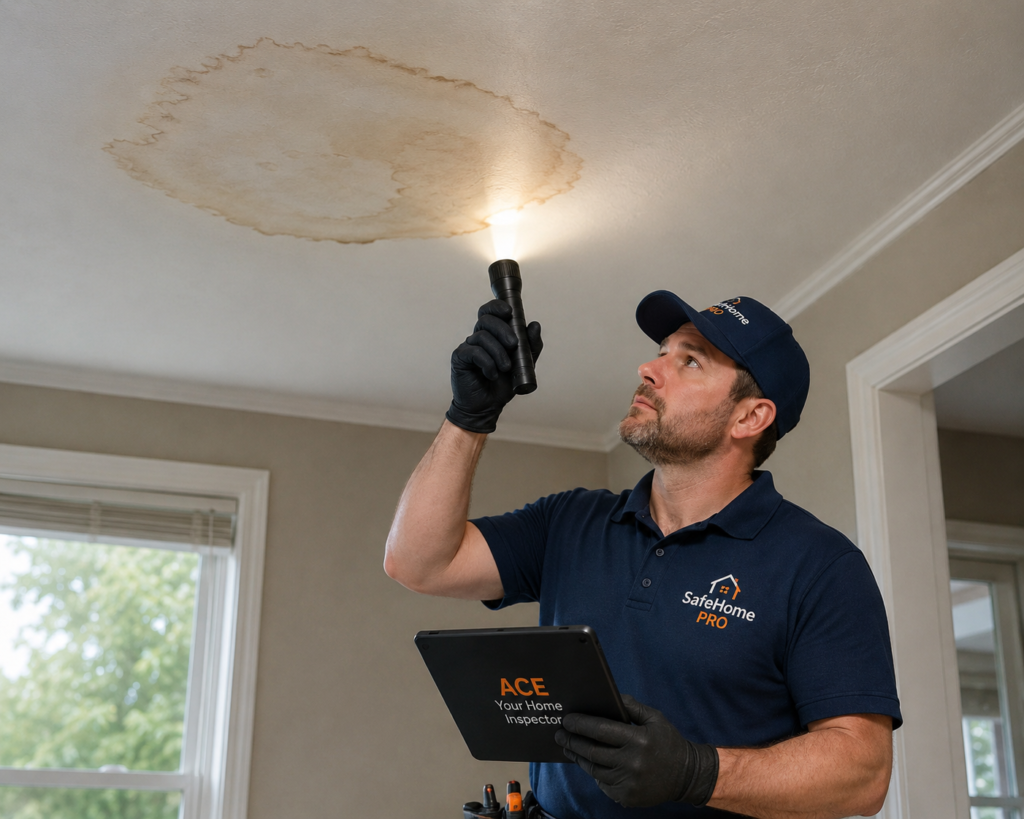
Roof Leak vs Condensation: How Homeowners Can Tell the Difference
Roof leak vs condensation is one of the most common diagnostic questions homeowners face. The two problems often look identical from inside — ceiling stains, attic moisture, the same suspicion that “something’s leaking” — but the fixes are completely different. This guide gives you the practical signals that separate them.
Two Different Problems, Almost Identical Symptoms
From the living-room side, a roof leak and an attic-condensation event can produce the same evidence: a damp ceiling, a brown stain, a musty smell, paint bubbling, or sagging drywall. Both involve water reaching the underside of the roof deck and dripping down. But the source — and therefore the fix — are completely different.
A roof leak is water entering from outside: through a failed shingle, a lifted flashing, a deteriorated boot on a vent stack, ice damming under shingles, or a hole in the deck. The fix is exterior — new shingles, new flashing, sealed penetrations.
Attic condensation is water generated inside the home: warm humid air from showers, cooking, laundry, and breathing rises through air-leakage paths into a cold attic, hits the cold underside of the roof deck, and condenses there. The fix is interior — air sealing, ventilation, insulation. Replacing a roof to fix condensation is one of the most expensive mistakes homeowners can make.
Knowing which one you have, before you call anyone, saves an enormous amount of money.
Trying to figure out which one it is?
Describe when the stain appears, where it sits, and what you can see in the attic — ACE will help you tell a roof leak from a condensation pattern.
When Does the Symptom Show Up?
Timing is the single strongest signal. Track when the staining or dripping appears and you’ll usually narrow the cause within one or two events.
| When you see it | Likely |
|---|---|
| During or right after rain | Roof leak |
| During heavy windblown rain only | Roof leak (often flashing) |
| Day or two after a heavy snowfall + warm spell | Ice dam (variant of roof leak) |
| Coldest weeks of winter, no rain | Attic condensation |
| Recurring January or February staining | Attic condensation |
| Symptom appears with shower / cooking / laundry | Attic condensation |
| Continuous, unrelated to weather | Plumbing or HVAC, not roof |
Where on the Ceiling Does It Show?
Roof leaks usually have a localized source — a single penetration, a single damaged area, a single seam. The result is often a single, defined stain. Attic condensation is generated everywhere humid interior air can reach, so its evidence tends to be diffuse.
- Single, defined stain — especially under a vent pipe, chimney, skylight, valley, or roof edge: roof leak.
- Multiple stains across a top-floor ceiling, or stains in straight lines following framing: attic condensation.
- Stain along an exterior wall near the eaves, in winter only: ice dam.
- Stain directly above a bathroom that’s on the top floor: usually condensation from inadequate exhaust venting.
- Wet ring of insulation directly above a single ceiling spot: roof leak.
- Frost on roof nail tips visible from inside the attic in winter: condensation, full stop.
What the Attic Itself Tells You
If you can safely access the attic with a flashlight, the underside of the roof deck and the framing usually tell you within a minute. Step on joists only, never on insulation. Look at the deck and rafters with a flashlight at a low angle.
Roof leak signals (in the attic)
- Localized darkened sheathing in one area.
- Daylight visible at flashings, vents, or seams from inside.
- Wet, matted insulation directly under a single roof penetration.
- Streaks running down a single rafter.
- Rust on a single set of nails or fasteners around one penetration.
Condensation signals (in the attic)
- Frost or beads of moisture on roof-deck nails in winter.
- Darkened sheathing across a wide area, especially the north slope.
- Mold or staining on the underside of the deck spread broadly, not localized.
- Wet bath fan duct, dryer duct, or kitchen exhaust dumping into the attic instead of outside.
- Inadequate or blocked soffit and ridge vents.
- Insulation thin or compressed at the perimeter, allowing warm humid air to reach the deck.
For a fuller checklist of what attic moisture looks like, read our attic moisture signs guide. It pairs naturally with this one.
Why the Distinction Matters for Repair Cost
The fixes for these two problems share almost no overlap. Misdiagnosing condensation as a roof leak can lead to roof replacements that solve nothing.
If it’s a roof leak
- Localized shingle and underlayment repair.
- Flashing replacement around chimney, skylight, or vent pipes.
- Boot replacement on plumbing vent stacks.
- Valley re-flashing on older roofs.
- Full re-roof when shingle life is exhausted.
If it’s attic condensation
- Air sealing penetrations between the home and attic (the highest-impact step).
- Adding or improving attic insulation, especially at the perimeter.
- Improving soffit-to-ridge ventilation.
- Re-routing bath, dryer, or kitchen exhaust ducts to terminate outside, not into the attic.
- Reducing interior humidity sources (running bath fans longer, fixing basement humidity, using HRV/ERV in tighter homes).
Replacing the roof to fix what is actually a condensation problem. New shingles don’t change the dew point on the underside of the roof deck. Diagnosing this correctly before any roofing work begins is essential.
Practical Homeowner Investigation
- Track when the symptom shows up. Mark a calendar for two cycles — rain events, cold spells, fixture use.
- Note the location pattern — single spot or many, exterior wall or interior, near a penetration or not.
- Look at the attic with a flashlight after rain and after a cold snap.
- Check that bath fans, dryer, and kitchen exhaust all terminate outside the home.
- Run a hand at outlet covers on top-floor ceilings — cold drafts often mean attic air-leakage paths that drive condensation.
- Photograph anything that catches your eye in the attic; pros use these photos.
When to Stop Investigating
Roof leaks past a one-shingle repair are roofer territory. Attic condensation work usually involves an insulation/air-sealing contractor, not a roofer — and asking the right contractor matters. For mixed-signal cases, a full home inspection is the most efficient mapping of a multi-cause problem. For widely-cited remediation guidance on contaminated drywall and attic decking, see the EPA mold cleanup guidance.
Frequently Asked Questions
Almost certainly not a roof leak. Winter-only staining is typically attic condensation, sometimes paired with ice damming. The fix is air sealing, insulation, and ventilation — not new shingles.
Yes — condensation forms on the underside of the cold roof deck, drips onto insulation, and shows up as ceiling stains below. The water source isn’t the rain; it’s humid interior air making it into the attic.
Sometimes, but not always. Ventilation only works when air sealing has already cut off the warm humid air from below. Adding vents to a leaky ceiling sometimes makes it worse by drawing more conditioned air up.
Both. Ice dams form because heat is escaping into the attic (a condensation-style problem) and then water backs up under shingles (a roof-leak-style problem). The long-term fix is air sealing and insulation; the short-term fix is removing the dam carefully.
No. Dehumidifying a vented attic doesn’t work — the attic exchanges air with the outside. The fix has to be at the source: stop humid interior air from reaching the attic and improve drying of any moisture that does make it up.
Yes. That’s one of the most common drivers of attic condensation in newer homes. Bath, dryer, and kitchen exhaust all need to terminate outside the building envelope, with insulated ducting in cold-climate runs.
Continue Reading
The full plain-language hub on home moisture — where it comes from, what it does, and how to read it.
Open the hub ›Reading the pattern of a ceiling stain — size, shape, edges, timing.
Read guide ›A homeowner’s read on what attic moisture looks like and what it usually means.
Read guide ›The early warnings — before drywall sags or paint blisters.
Read guide ›Old vs new, deposits vs growth, and the right repair sequence.
Read guide ›A connected indoor-humidity signal — what window fogging tells you about the home.
Read guide ›A free seasonal walkthrough — the easiest way to catch problems early.
Open the checklist ›Roof Leak or Condensation? Let ACE Help You Figure It Out.
Tell ACE when the staining shows, where on the ceiling, and what your attic looks like. Get a plain-language read of the most likely category — before you spend money on the wrong fix.