
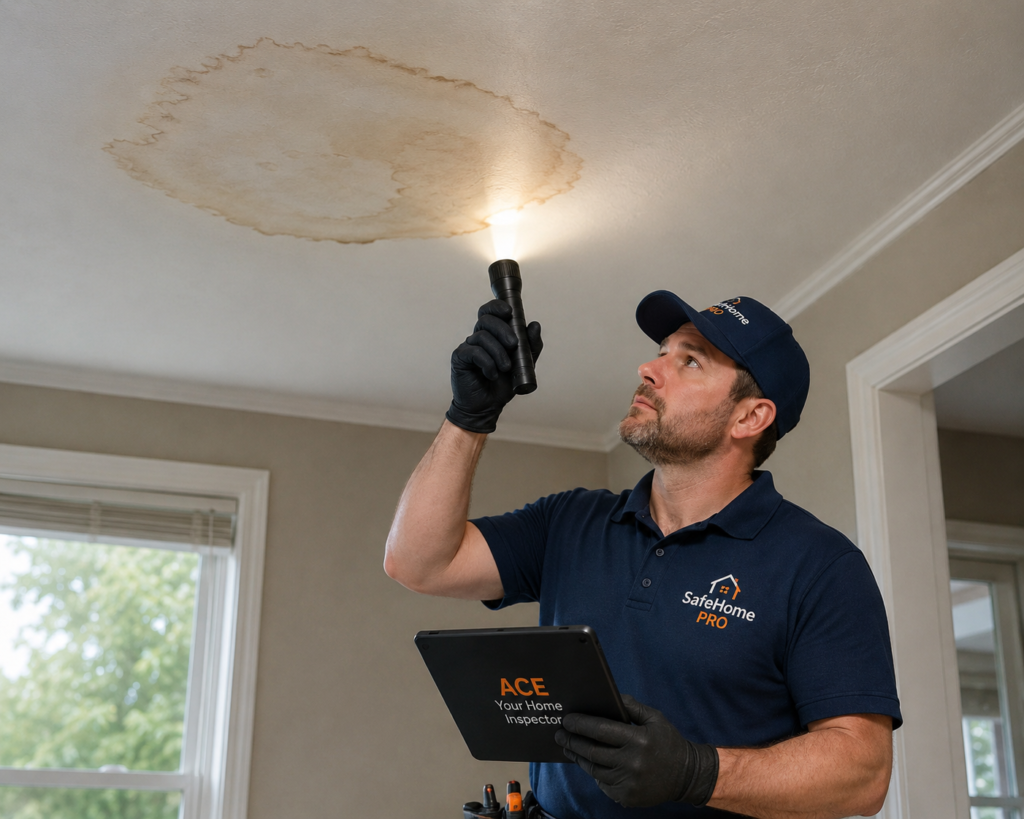
Brown Spots on Ceiling: What They Mean and What Homeowners Should Do
Brown spots on ceiling drywall almost always tell a story about water — sometimes recent, sometimes years old, sometimes still active. This homeowner guide walks through how to read the color and pattern, how to tell historic from active, and the practical steps to take before paint or repair.
Why Brown Spots on Ceiling Drywall Form
Most brown spots on ceiling drywall form when water saturates gypsum, paint, paper backing, or the wood framing above — then evaporates and leaves behind whatever was carried with it. The color usually comes from one of four contributors:
- Tannins from wood framing or roof decking. When water passes through old wood, it picks up natural extractives that bleed through paint as a yellow-brown ring.
- Iron and rust from fasteners. Nails or screws under saturated drywall corrode and bleed orange-brown haloes.
- Mineral deposits from concrete, masonry, or older roof underlayment. Water carrying calcium, lime, or asphalt residues deposits them at the evaporation edge.
- Biological growth. Some moulds and mildews leave a brown-to-black tint, particularly along the perimeter of long-saturated areas.
The same brown spot on two different ceilings can mean two different things. The pattern, edge quality, color tone, and history matter more than the spot itself.
Brown spot you're trying to place?
Describe its color, edges, location, and whether it's grown — ACE will help you tell historic deposits from active staining and what to do next.
Telling a Historic Stain From an Active One
The single most useful question a homeowner can ask: has this spot changed? A stain that has stayed the same size, shape, and color for months or years is almost always a historic record of past damage — and the source has either been fixed or has stopped on its own. A stain that has grown, darkened, sprouted new rings, or returned after painting is active.
| Clue | Likely historic | Likely active |
|---|---|---|
| Edge quality | Sharp ring, defined perimeter | Soft, fuzzy, expanding |
| Color tone | Faded, pale yellow-brown | Darker, sometimes wet-looking |
| Drywall feel | Firm, slightly chalky | Soft, spongy, cool |
| Ceiling sheen | Matches surrounding paint | Slightly different reflectance |
| Behaviour after rain | No change | Grows or darkens |
| Behaviour after painting | Stays hidden under stain-blocker | Bleeds back through |
If the stain bleeds back through fresh paint after a stain-blocking primer, the moisture source is still feeding the area — full stop. Find the source first; paint is the last step, not the first.
What Different Brown Tones Suggest
Yellow-brown
Classic tannin-style staining from older wood framing or roof decking. Often associated with one-time saturation events — a fixed leak, a one-storm overflow, an HVAC pan that’s since been drained.
Orange-brown
Iron and rust deposits, frequently from a corroded fastener under the drywall surface. A row of orange-brown dots along a ceiling line often points to drywall screws or nails. Recurring orange-brown rust patterns can also mean attic-side condensation around metal flashing or vents.
Dark brown to black
Sustained moisture, biological growth at the edge, or deposits from older asphalt-saturated underlayment carried down by repeated leaks. Treat darker tones as a stronger signal — not an emergency, but worth investigating before painting.
Greenish-tinged brown
Often associated with mildew or a mould colony at the perimeter of long-saturated drywall. Don’t scrub it dry; assess the area before deciding on remediation.
Color narrows the suspect list, but it doesn’t replace investigation. The combination of color + location + timing + edge quality is what actually points to a cause.
When a Brown Spot Is Just Cosmetic vs When It Isn’t
Most isolated, dry, sharp-edged brown spots are cosmetic. They tell you something happened, but the something has stopped. The patterns below are different and deserve a closer look:
- Multiple brown spots in a row or grid (often points to a system-wide attic-condensation pattern).
- Brown spots that recur in the same place after fresh paint.
- Brown spots paired with a musty smell.
- Brown spots near light fixtures, ceiling fans, or smoke detectors that show signs of corrosion.
- Brown spots paired with bubbling paint, soft drywall, or sagging.
- Brown spots after a recent storm event — especially with rain-driven wind.
Practical Homeowner Investigation Steps
- Mark each spot in pencil and date it. Re-check in 30 days.
- Check what’s above — bathroom, attic, HVAC, or open roof line.
- Look for a row pattern; multiple aligned spots usually mean fasteners, not a single leak.
- Touch each spot lightly. Cool, soft, slightly damp = active. Dry, firm = historic.
- If accessible, check the attic side of the same area with a flashlight after rain.
- Photograph everything — you’ll want a record either way.
- Run plumbing tests if a bathroom is directly above.
- Use the DIY home inspection checklist for the broader walkthrough.
The Right Order: Source, Dry, Treat, Paint
Skipping any step in this sequence is the most common reason “painted-over” ceiling stains return.
- Find and stop the source. Until water stops arriving, repair is cosmetic only.
- Dry the area thoroughly. Often a week or two of normal indoor conditions; longer if drywall was saturated.
- Treat any biological growth per EPA mold cleanup guidance. Small surface growth on solid drywall can sometimes be cleaned; saturated drywall with growth should be cut out.
- Apply a stain-blocking primer. Shellac-based (BIN-style) is the most effective for tannin and rust bleed-through. Spot-prime, then full-coat.
- Repaint with the matching ceiling paint. Two coats, soft edges, allow full cure between coats.
Frequently Asked Questions
Almost always. The exceptions are nicotine staining in older homes, cooking grease in poorly-ventilated kitchens, and dust deposits at HVAC outlet grilles. All of those have a different pattern (broad, gradual, system-related) than water-driven spots (rings, halos, edges).
Only after you’ve confirmed the source has been stopped, the drywall is dry, and you’ve used a stain-blocking primer first. Latex paint alone won’t hold tannin or rust bleed-through.
Either the moisture source is still active or the topcoat went on without a stain-blocking primer. Both are common. The fix is to find the source first, then prime with shellac-based stain blocker, then repaint.
If the drywall is firm and dry and the source is fixed, no — surface treatment is enough. If the drywall is soft, sagging, or shows biological growth that won’t clean off, cutting out the affected section and replacing it is the safer route.
Color reflects what the water carried. Orange usually means rust from fasteners or metal flashing. Yellow-brown is tannin from wood. Darker tones can mean older deposits or biological growth. Color narrows the source list but doesn’t replace investigation.
Not by itself. Mold needs sustained moisture for at least a day or two. A one-time event that dried quickly often has no growth. Recurring spots, fuzzy edges, or a musty smell are different signals.
Probably yes, indirectly. That pattern is fasteners corroding from sustained attic-side moisture. The drywall and paint may be fine, but the upstream issue is usually attic condensation or ventilation, not a roof leak. Read our attic moisture signs guide for the upstream diagnosis.
The cosmetic part is inexpensive — a can of shellac-based stain-blocking primer and matching ceiling paint is usually under $50 for a homeowner doing it themselves. The real cost is whatever is causing the moisture. Stopping the source can range from a minor fix (resealing a vent boot, clearing a condensate line) to a larger repair (roof flashing, plumbing, or attic ventilation work). Always price the source fix first — painting before the source is stopped just means paying twice.
Two causes dominate in bathrooms: a plumbing leak from the floor above, or condensation from shower humidity that isn’t vented outside. If the spot is worse right after showers and the room stays foggy, suspect ventilation — an exhaust fan that’s undersized, unused, or vented into the attic instead of outdoors. If the spot grows regardless of showering, suspect a supply or drain leak above. The attic moisture signs guide helps when the bathroom is on the top floor.