
Frost in Attic: Causes, Warning Signs and Solutions
Frost in attic spaces almost always points to one thing: warm, humid indoor air leaking up into the cold space above your ceiling. The frost itself isn’t the problem — it is the visible end of an indoor-air leak. This guide is a symptom-first read for what to do next; for the full physics of how warm air becomes frost on cold sheathing, the attic condensation warning signs guide goes deeper.
Why Frost Shows Up in an Attic
Every home produces moisture — cooking, showering, breathing, indoor plants, humidifiers. In a well-sealed home, most of it exits through bath fans, kitchen exhausts, and dryer venting. In a leaky home, a significant fraction rises with warm indoor air through bypasses in the ceiling and ends up in the attic.
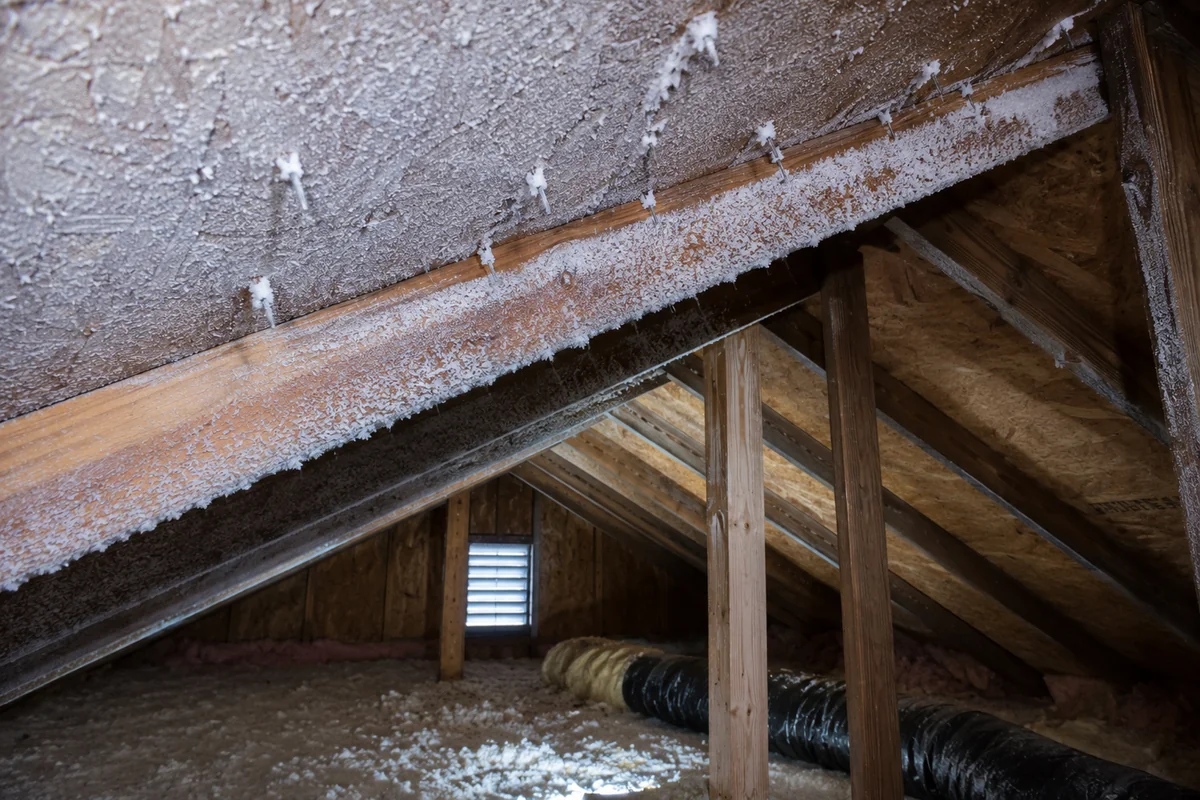
Once that warm humid air meets the cold underside of the roof sheathing, the water vapor gives up its water. On cold winter days, it goes straight from gas to ice and you see frost — sometimes a thin glaze, sometimes furry crystals on the tips of roofing nails, sometimes a heavy white coating on the north-facing slope.
Frost is harmless while frozen. The trouble starts during a warm spell when it melts: water drips onto insulation, runs along rafters, finds ceiling penetrations, and shows up as a stain in a room below. The faster a homeowner reads the frost correctly, the simpler the fix usually is.
Seeing frost in your attic?
Describe what you found, the season, and where the frost sits — ACE will walk you through the likely causes and which homeowner check to try first. Educational guidance only, not a diagnosis.
What You’re Likely to See First
Most homeowners discover attic frost while opening the hatch for an unrelated reason in winter, looking after a ceiling stain appears, or after a contractor or inspector flags it. What stands out depends on how long the issue has been building.
Frost on the tips of roofing nails
The most common first sign. Tiny crystals or a small white tuft on each protruding nail, especially clustered above areas of higher indoor humidity (bathrooms, kitchens, laundry rooms). On its own and on the coldest mornings of the year, light nail-tip frost is common in cold climates and not necessarily a problem.
A white or silver glaze across the sheathing
A thin, even coating of frost on the underside of the roof deck — particularly on the north slope — means the indoor moisture source is steady and the attic ventilation isn’t carrying it out fast enough. Once that pattern repeats over multiple winters, dark grey or black staining appears on the wood underneath. The attic moisture signs guide covers what dark staining patterns usually mean.
Wet or matted insulation around fixtures
Compressed, discolored, or damp insulation around the attic hatch, near a bath-fan duct, or above a recessed light points to the air-leak source directly. Wet insulation also signals that the frost cycle has gone past the dry stage.
A ceiling stain in a top-floor room below
If frost melts often enough, water finds a ceiling penetration and stains the room below. A new spot under the attic hatch, a bath-fan housing, or a pot light — one that gets worse after winter warm spells — is a classic attic-frost pattern showing up indoors. See peeling paint from moisture for what comes next.
The Most Common Causes of Frost in Attic
The underlying mechanism is the same in nearly every case — indoor air leaking into a cold space — but the specific leak path differs. These are the patterns homeowners can usually identify themselves.
1. The attic hatch isn’t sealed or insulated
A bare plywood hatch with no weatherstripping is the single biggest air leak in many attics. Warm humid air rises right through the gap. Hatch covers can be air-sealed with foam tape and an inexpensive insulation panel. This is usually the first place to look.
2. Bath fans venting into the attic instead of outside
A bath fan whose flex duct just dumps into the attic, terminates a few inches above the insulation, or vents into a soffit cavity is a steady humidity source every time someone showers. Bath fans should terminate through a dedicated wall or roof cap, away from soffit intakes. Check above bathroom ceilings first.
3. Recessed lights, can lights, and ceiling penetrations
Older non-airtight pot lights leak indoor air into the attic continuously. Other ceiling penetrations — plumbing vents, electrical chases, the top plates of partition walls — do the same. Frost concentrated above these features confirms the path.
4. High indoor humidity in winter
A whole-house humidifier set at 45–50%, an unvented gas appliance, indoor laundry drying, or a finished basement with no ventilation can all push the indoor humidity above what the building envelope can handle in cold weather. Persistent window condensation is a useful tell — if windows are fogging, the attic is collecting moisture too. See condensation on windows for the related guide.
5. Inadequate or unbalanced attic ventilation
Even with modest indoor humidity, an attic that can’t move air through itself will accumulate moisture. Blocked soffit vents, missing ridge or gable venting, or a power attic fan working against the natural stack effect are common patterns. A house that was “leaky enough to dry itself” before an energy retrofit can also show frost the first winter after new windows or air-sealing work — the fix is mechanical ventilation, not removing the upgrade. The attic condensation guide explains the ventilation diagnostic in depth.
Frost vs. a Roof Leak: How to Tell Them Apart
Attic frost and roof leaks both end with water on the deck and sometimes a ceiling stain below. The patterns separate with a few questions.
- Timing: attic frost shows up in deep cold and worsens after warm spells. A roof leak follows rain, snowmelt, or wind-driven precipitation.
- Location: attic frost is broad — whole slopes, large areas, or concentrated above indoor-humidity sources. A roof leak is localized to a specific penetration: a vent stack, a chimney, a flashing, a damaged shingle.
- Direction of moisture: with frost, the water moves from the inside of the home up. With a leak, the water moves from outside in.
- Indoor humidity correlation: attic frost gets worse on the days you can also see condensation on your windows. A roof leak does not.
If both cold and recent rain are in the picture, the roof leak vs condensation guide walks through mixed-cause diagnostics.
When to Monitor and When to Act
Not every winter frost finding is urgent. The severity scale most homeowners can use:
| What you see | What it usually means | What to do |
|---|---|---|
| Light frost on a few nail tips on the coldest morning of the year | Routine seasonal condition in cold climates | Note the location; recheck on the next cold morning |
| Continuous glaze across one or both roof slopes | Indoor moisture source plus ventilation gap | Identify and address the humidity source this season |
| Heavy frost plus damp or matted insulation | Wet-dry cycles are already producing water on melt days | Air-seal the path, fix bath-fan venting, consider a pro review of the ventilation |
| Dark grey or black staining on sheathing | Repeated wet cycles over multiple winters | Plan a professional inspection of the attic and ventilation system |
| Active dripping during a thaw, or a fresh ceiling stain below | Frost cycle is now actively delivering water indoors | Address the source within the season; consult a professional |
None of the rows call for same-day action on their own — the table is a calibration tool, not a contractor-call trigger.
What Homeowners Can Safely Investigate
Checks any homeowner can do with a flashlight, on a cold day, without specialized tools:
- Open the attic hatch on a cold morning and look. Most frost is visible within a few feet of the hatch.
- Note where the frost is heaviest — over bathrooms, the kitchen, the laundry room, the attic-hatch perimeter. The location points at the source.
- Check the attic-hatch cover: is it weatherstripped? Does it have insulation? A bare plywood lid is the most common quick fix.
- Trace the bath-fan duct: does it run all the way to a wall or roof cap, or does it just stop in the attic?
- Check your hygrometer (or any indoor-humidity reading): if it shows above 40% on cold winter days, that is on the upper end of what most homes can carry without attic moisture problems.
- Step outside and look at the soffits and ridge: are vents blocked with insulation, paint, or debris?
- Use the DIY home inspection checklist as a seasonal walkthrough — the attic walk and the indoor-humidity check are both on it.
A few cautions: don’t walk on attic insulation (no footing, and the drywall below won’t hold a person), don’t poke around electrical fixtures from the attic side, and don’t handle wet insulation near live wiring.
When a Professional Review Makes Sense
Most attic frost issues can be reduced with weekend-level homeowner work — weatherstripping a hatch, ducting a bath fan, dialing down a humidifier, clearing soffit baffles. A professional review is worth considering when:
- The frost is heavy across the full sheathing, not just over known moisture sources.
- You already fixed the obvious indoor-air leaks and the frost still returned the following winter.
- The attic ventilation balance needs to be recalculated — intake-vs-exhaust math, vent net-free-area, or a venting redesign.
- You are seeing sheathing staining, wet insulation, or any sign that the moisture has been at work for more than one season.
- A ceiling stain has appeared in a room below and you want a structured opinion before painting over it.
A qualified home inspector or building-envelope specialist can read the patterns in person and propose a sequenced fix that matches your house.
Frequently Asked Questions
Frost itself is not a hazard while it remains frozen. The reason it is worth addressing is what happens when it melts and what it tells you about ongoing indoor humidity. Light seasonal frost on the coldest mornings is common and usually fine. Heavy frost, frost that doesn’t fully clear during warm spells, or any wet insulation crosses into “worth doing something about this winter” territory.
A single mild winter of light frost rarely causes lasting damage. The pattern that produces real consequences is a frost-melt-refreeze cycle across multiple winters — that is when sheathing staining, wet insulation, and microbial growth start to appear. If you spotted frost this winter, plan to identify the source before next winter, not the same week.
Not on its own, and in some cases it can make things worse if it covers soffit vents. Insulation reduces heat loss but does not seal air leaks — and it is the air leaks carrying humid indoor air into the attic that produce the frost. The reliable order is: air-seal first, then verify the ventilation path is clear, then insulate. The attic condensation guide covers the air-sealing-first principle in more depth.
Two identical houses can have very different indoor humidity profiles. Family size, humidifier setting, indoor laundry drying, even cooking style change the moisture load. Small differences in the attic build — a tighter hatch, a properly ducted bath fan, or clearer soffit vents next door — can produce a dry attic next to a frosted one.
Yes, often. A whole-house humidifier set at 45–50% in deep winter pushes the indoor air to a moisture level the building envelope can’t hold. The moisture finds its way up. A useful homeowner rule: dial the humidifier down until persistent window condensation goes away — if windows are fogging, the attic is collecting moisture too. Many homes find their winter sweet spot between 30–40% relative humidity.
Powered attic ventilators are debated. In a leaky house they often pull conditioned indoor air up through the ceiling and increase attic humidity rather than reducing it. Passive soffit-to-ridge ventilation paired with serious air sealing is the more reliable approach for most homes; a powered solution, if needed at all, should follow a venting-balance review, not lead it.
Continue Reading
The full physics of how warm indoor air becomes frost on cold sheathing — with the cause list and fixes in depth.
Read guide ›Where home moisture shows up, organized by the patterns homeowners actually notice.
Open the hub ›Which of the two is responsible for a ceiling stain — timing, location, and the attic clues.
Read guide ›The broader signal list — leaks, ventilation, animal entry, seasonal patterns beyond frost alone.
Read guide ›The eaves-side consequence of the same heat-loss and moisture path that produces attic frost.
Read guide ›A seasonal walkthrough that includes the attic-hatch check, humidity reading, and roof-edge points.
Open the checklist ›Spotted Frost in Your Attic? Show ACE What You’re Seeing.
Describe where the frost sits, what the indoor humidity is reading, and which moisture sources are above the affected area — ACE can walk you through likely causes and which homeowner check is worth trying first. Educational guidance, not a diagnosis.