
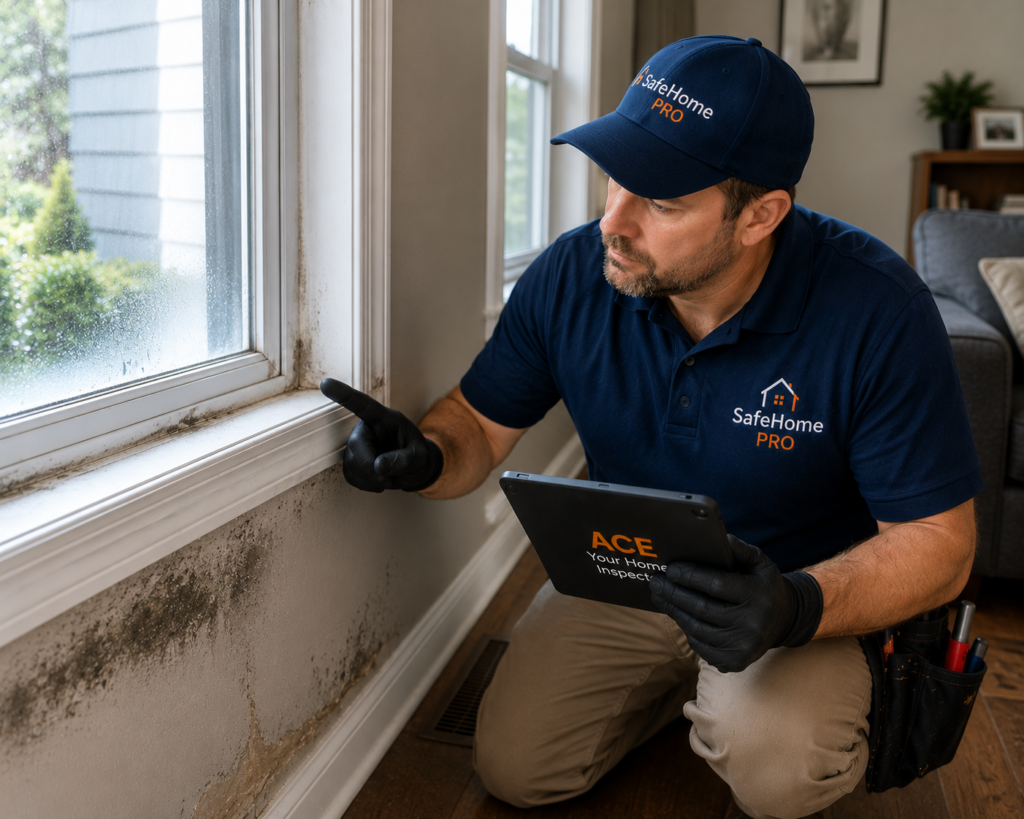
Peeling Paint From Moisture: What It Usually Means and the Right Order of Repair
Peeling paint from moisture is the most common “cosmetic” problem that isn’t actually cosmetic. The paint film is the surface telling you that something underneath it is wet, was wet, or keeps getting wet. This guide explains how to read which kind it is, the patterns that point to bathroom, kitchen, basement, or exterior sources, and why repainting alone almost never holds.
Why Peeling Paint Is a Signal, Not a Finish Problem
Modern interior paint is engineered to flex with the wall under it. When it starts blistering, sheeting off, or curling at the edges, the cause is rarely the paint itself — it’s that the substrate underneath has lost its grip. The most common reason a substrate loses its grip is moisture, either trapped under the paint or steadily reaching it from behind. Peeling paint from moisture is the home’s way of pointing at a moisture source the homeowner often hasn’t noticed yet.
That’s why repainting on its own almost never holds. A fresh coat over a still-wet wall pushes the same problem out by a few months and usually returns wider. The right approach is to read the pattern, identify the source, dry the substrate, prep properly, and only then repaint. This page is built around that sequence — pattern first, source second, repair third.
Paint peeling and you suspect moisture?
Describe where the peeling is and what's around it — ACE will help you tell moisture-driven failure from old paint and why repainting alone won't hold.
The Patterns That Show Up First
Most homeowners come to this issue after seeing one of a small handful of patterns. The location, shape, and timing of the peeling tell you a lot before you ever touch it.
Bathroom ceilings sheeting off in flakes
Often appears as long strips lifting away from the ceiling, sometimes with curled edges or a faint discoloration underneath. The ceiling above a shower stall is the most common location. Almost always points at bathroom humidity that the exhaust fan isn’t clearing fast enough.
Round, soft blisters on a ceiling
A bubble that yields when you press it, sometimes with water inside, is a different conversation — closer to bubbling paint on ceiling. The substrate is actively wet from above.
Flaking near a baseboard or where wall meets floor
In a basement or ground-floor exterior wall, peeling that’s concentrated in the bottom 12–24 inches usually points at moisture wicking up from the slab or foundation rather than down from above.
Peeling on exterior siding under a window or gutter
An exterior strip of bare wood under a windowsill, gutter seam, or fascia almost always traces back to water intrusion at that joint — not paint failure. Repainting without sealing the joint repeats the cycle within a year.
Kitchen wall paint lifting near the range or sink
Kitchens generate steam plus airborne grease, both of which stress paint. Peeling concentrated near steam-producing surfaces is the common signature.
Cold-corner peeling on exterior walls in winter
A patch of peeling at the upper corner of an exterior wall, often behind furniture, points at condensation forming on a cold spot caused by thermal bridging or missing insulation.
What Actually Causes Peeling Paint From Moisture
1. Elevated indoor humidity
Persistent indoor relative humidity above 50% in winter pushes moisture into every porous surface in the house. Drywall absorbs it slowly. Paint, which sits on top of that drywall, starts losing its grip as the substrate swells and contracts. Bath, kitchen, and laundry rooms feed this if their ventilation is undersized or off.
2. Bathroom and kitchen ventilation that’s undersized or misvented
An exhaust fan that’s too small, too short, runs too briefly, or vents into the attic instead of outside doesn’t actually remove moisture — it just relocates it. Paint above showers and near range hoods is the first surface to react.
3. Hidden plumbing leaks
A weeping supply fitting behind a bathroom wall, a leaking shower pan, a slow drain leak under a sink, or a pinholed copper line can keep drywall steadily damp without ever producing visible water on the surface. The paint above tells you long before any pooling shows.
4. Foundation seepage rising up basement walls
Moisture entering through a foundation wall doesn’t always pool — it can wick up several inches into drywall, plaster, or paneling, lifting the paint at the bottom of the wall.
5. Cold-surface condensation
Exterior-wall corners, single-pane window jambs, and uninsulated bays behind kitchen cabinets get cold enough in winter that warm interior air condenses on them. The paint sits on a substrate that gets visibly damp on cold mornings and dries out by afternoon, week after week, until it finally lifts.
6. Exterior water intrusion through siding, trim, or roof edge
Failed caulking around a window, a clogged gutter spilling at the eave, a flashing detail that’s past its life, or wind-driven rain pushing through a seam — any of these can put moisture into wall cavities that show up on the interior paint long before there’s a visible water stain.
7. Painting over a damp or contaminated surface
Sometimes the original paint job is the source. Paint applied over a damp basement wall, over efflorescence, over an unsealed concrete patch, or over old oil paint with no proper prep will release months later. The cure is full removal and proper prep, not another topcoat.
How ACE Reads a Peeling-Paint Photo
When a homeowner uploads a peeling-paint photo, the first thing ACE looks at is location and pattern, not the paint itself. A ceiling above a shower, a strip at the bottom of a basement wall, a cold-corner patch behind furniture, and a long flake on an exterior gutter board are four entirely different conversations. The second clue is the edges: clean, hard edges with curl usually mean the substrate is dry now and the failure is historic; soft, fuzzy edges with discoloration usually mean it’s still active.
The third clue is what’s under the lifted flake. If the drywall paper underneath is dark, soft, or stained, the moisture is at the surface. If it looks dry and chalky but the paint still came off cleanly, you’re usually looking at an old painting-over-damp issue rather than something currently leaking. ACE will walk through these reads with a homeowner from a photo and a couple of questions about season and location.
When to Monitor and When to Worry
| What you’re seeing | Read | Action |
|---|---|---|
| A small flake or two near a bathroom ceiling, dry under the paint | Past humidity event | Improve fan use, scrape, prime, repaint |
| Strip of peeling that returns after every repaint | Active underlying moisture source | Find the source before repainting again |
| Soft, dark drywall under a lifted flake | Currently wet substrate | Stop the source, dry the wall, then repair |
| Peeling plus visible mold patches | Sustained dampness has supported growth | Address source, clean per EPA mold guidance, then repair |
| Bottom-of-wall peeling in a basement | Foundation wicking moisture | Exterior drainage check, dehumidify, foundation assessment |
| Exterior siding peeling under a window or gutter | Water intrusion at that joint | Address joint/flashing before repainting |
| Sheets of paint coming off plus a buckled or sagging wall | Long-term saturation | Professional assessment of structure and material |
The pattern is consistent: small and stable usually means the moisture event is over and you can repair. Persistent, returning, or spreading peeling means the moisture source is still active and any repair work will fail until you address it.
What Homeowners Can Investigate Safely
- Press a peeled edge. If the drywall paper or plaster underneath feels soft, cool, or damp, the substrate is still wet.
- Buy a pin-style moisture meter ($25–50). Check several spots near the peeling and a reference spot elsewhere on the same wall. A 5+ point difference is a strong signal.
- Take a humidity reading in the room with a $20 hygrometer. Bath, kitchen, and laundry that sit above 60% during use need ventilation attention.
- Time the bath fan: it should run during the shower and for 15–20 minutes after. Hold a tissue against the grille — if it doesn’t pull strongly, the fan or the duct is the bottleneck.
- Confirm bath and kitchen exhausts vent outside, not into the attic or soffit. Walk outside and find the termination cap.
- For basement peeling, walk the exterior after a rainstorm. Confirm downspouts dump well away from the foundation and the ground slopes away from the home.
- For cold-corner peeling, look at where the patch is. Behind a sofa? Against an exterior wall? Likely a cold-surface condensation problem.
- For exterior peeling, look directly above the failed area for the water source — a gutter, a flashing, a caulk joint, a missing piece of trim.
- Photograph the area from a fixed angle. Re-photograph in 3 and 6 weeks. Growth tells you the source is still active.
- Review the DIY home inspection checklist for the matching walkthrough.
When Outside Help Becomes the Right Call
Peeling paint that keeps returning despite repairs almost always means the source hasn’t been correctly identified. That’s the point at which an outside eye usually pays for itself. Bring in a professional when:
- The peeling pattern points at hidden plumbing — bathroom wall, under-sink area, behind a kitchen cabinet — and DIY investigation hasn’t located a source.
- Basement wall peeling is paired with efflorescence, staining, or recurring damp; this is usually a foundation/waterproofing contractor conversation.
- Visible mold has spread beyond a small spot, or the affected area is larger than roughly 10 square feet.
- Exterior peeling shows up alongside soft trim, missing flashing, or visible rot. That’s a building-envelope question.
- Anyone in the home is experiencing respiratory symptoms tied to the affected room.
Before any of that, send ACE a photo and a description — upload a problem — for a quick, calm read on which conversation it actually is.
Frequently Asked Questions
Almost never with lasting results. Repainting an actively damp surface re-traps the moisture against the new coat and the failure returns — usually wider. The cure is identifying the moisture source, drying the substrate, prepping properly (scrape, sand, prime with a stain-blocking primer), and only then repainting.
The paint film itself usually isn’t — the moisture source behind it is the concern. Persistent dampness behind paint supports mold growth and weakens drywall and plaster. Older homes built before 1978 may have lead paint, which becomes a hazard once it’s chipping or being scraped; have it tested before disturbing it.
Either the fan is undersized for the bathroom, runs too briefly, or doesn’t actually vent outside. A correctly sized fan running during the shower and 20 minutes after, venting straight to the outdoors, prevents almost all bathroom-ceiling peeling.
Usually not foundation failure — usually moisture wicking through the wall from the exterior side. The fix is exterior drainage (downspouts, grading), interior dehumidification, and often professional waterproofing if the wicking is persistent. See wet basement warning signs.
Cold-weather peeling almost always points at condensation on cold interior surfaces — corners, behind furniture, single-pane windows. Warm humid indoor air meets a cold spot, condenses on it, and the paint sits on a substrate that’s damp every cold morning. Insulation, air sealing, and lower indoor humidity all help.
Mold-resistant paint is helpful in bathrooms and damp basements but it’s not a substitute for fixing the underlying moisture. If the substrate stays wet, even mold-resistant paint will eventually fail. Pair the paint upgrade with humidity and ventilation work.
Old-paint failure is usually uniform across a whole wall, with the same age and condition everywhere. Moisture-driven peeling is concentrated — in one corner, along the bottom, above a fixture, behind furniture, under a window. Pattern is the tell.
Continue Reading
The full plain-language hub on home moisture — where it comes from, what it does, and how to read it.
Open the hub ›When the blister is actively wet — how to tell, and the right order of repair from source to finish.
Read guide ›The simplest indicator of the indoor humidity that drives cold-corner peeling on exterior walls.
Read guide ›The often-paired cold-surface mold problem — the same physics that lifts paint at corners.
Read guide ›The early signal that’s almost always present when basement-wall peeling has started.
Read guide ›A free seasonal walkthrough — the easiest way to catch the source of peeling before it spreads.
Open the checklist ›Paint Peeling and Not Sure Why? Show ACE the Spot.
Send a photo and a couple of details — room, season, humidity reading if you have it — and ACE will walk through what’s likely causing it and which order to fix it in.