
Attic Condensation: Why It Forms and How Homeowners Can Stop It
Attic condensation is one of the most misdiagnosed home problems — mistaken for a roof leak, brushed off as “just frost,” or noticed only when the insulation starts to mat down. The cause is almost always inside the house, not above it. This guide explains the winter physics, the three sources homeowners can usually fix themselves, and how to tell condensation apart from an actual leak.
Why Attic Condensation Looks Like a Roof Leak (But Usually Isn’t)
Attic condensation forms when warm, humid air from inside the home leaks into the attic and meets the cold underside of the roof sheathing. The vapor in that air gives up its water on the cold surface — as frost in deep cold, as droplets in shoulder seasons. When a warm spell follows, the frost melts and the water finds its way down: along a rafter, off the underside of the deck, onto the insulation, sometimes through a ceiling penetration and onto a homeowner’s ceiling below.
That last detail is why attic condensation gets misread as a roof leak. The ceiling stain looks like one, the timing feels like one, and a homeowner climbing into the attic in summer (when the symptom is invisible) finds nothing to point at. The diagnostic separation is straightforward once you know the patterns, and the fixes are almost always inside-the-house ventilation and air-sealing work — not roofing.
Attic looking damp or frosted?
Describe the sheathing, season, and where the moisture sits — ACE will walk you through the warm-air-vs-cold-deck physics and the practical fix.
The Signs of Attic Condensation
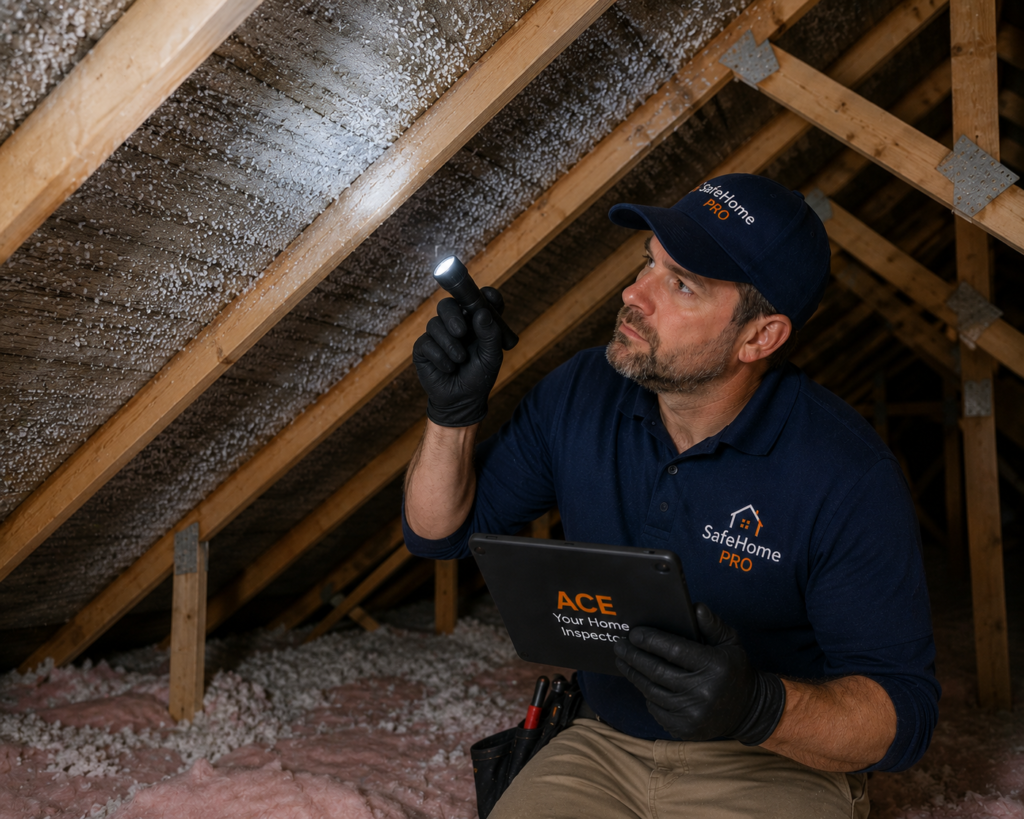
Frost on the underside of the roof sheathing
The clearest signal. On a cold winter day with the attic hatch open and a flashlight, frost across the underside of the roof deck, on nail tips poking through, or along the rafters is unambiguous attic condensation. It often shows up on the north-facing side of the roof first.
Dark staining on the underside of the roof deck
Dark grey or black patches on the sheathing, especially in the corners or above the soffits, are repeated wet/dry cycles plus microbial growth. Once you see this pattern, attic condensation has been a long-standing condition.
Wet or matted insulation
Insulation that’s compressed, discolored, or visibly damp around the attic-hatch perimeter, near recessed lights below, or around bathroom-fan ducts has been wet often enough to lose its R-value. The location of the wet insulation usually points straight at the air-leak source.
A ceiling stain near a bathroom or kitchen below
When attic condensation drips, it tends to find the path of least resistance — often through a ceiling penetration like a recessed light, a fan housing, or the attic hatch. A ceiling stain directly under one of these features, that’s worse after warm spells in winter, is a classic attic-condensation read.
Icicles or ice forming inside the soffit
If air can reach the underside of a soffit and freeze there, the same air is reaching the attic deck and freezing on it. Inside-the-soffit ice is the visible end of the same indoor-air leak.
Musty smell coming from the attic hatch
If opening the hatch in summer lets out a noticeably musty smell, the materials in the attic have been damp enough, long enough, to support microbial growth.
Where Attic Condensation Actually Comes From
Three causes account for the great majority of attic condensation problems homeowners run into. Almost every case maps to one of them — or to a combination of all three reinforcing each other.
1. Air leaks from the living space into the attic
The single biggest driver. Recessed light cans, the attic hatch, plumbing-stack penetrations, electrical penetrations, the top plate of interior walls, kitchen-fan ducts — every one of these is a potential bypass. Warm, humid indoor air rises through them by stack effect and dumps its moisture on the cold attic surfaces.
2. Bath fans and kitchen exhausts venting into the attic
Common in older homes and surprisingly common in homes that were renovated by non-specialists. A bath fan that ends in the attic or in a soffit, or a kitchen range hood that recirculates instead of venting outside, dumps the equivalent of several gallons of water vapor a week directly into the attic in winter.
3. Inadequate attic ventilation
A correctly ventilated attic has soffit-to-ridge airflow that constantly replaces attic air with outside air. When soffit vents are blocked by insulation, ridge vents are missing or buried under snow, or a power vent is undersized or off, indoor air that does leak in has nowhere to go. It sits, cools, and condenses.
4. Indoor humidity that’s too high for the season
An indoor humidifier set to 50% in -20°C weather, a long winter of damp basement air migrating upward, or simply a tightly built home with lots of occupants and showers can push winter indoor humidity past 50% — the point where every cold surface in the building starts collecting condensation, including the attic deck.
5. Missing or poorly fitted attic-hatch insulation
The attic hatch is the most-overlooked single weak point. A flimsy hatch with no gasket, no insulation on top, and no draft seal acts like an open chimney for indoor air every winter day. Wet insulation in a ring around the hatch is the giveaway.
6. New, tighter windows or weatherstripping without a corresponding ventilation upgrade
Tightening a leaky old house keeps moisture inside that used to escape through the building envelope. Without active ventilation (bath fans, kitchen exhaust, an HRV), indoor humidity climbs and condensation problems suddenly appear in attics that had been fine for decades.
How ACE Reads an Attic Condensation Photo
When a homeowner uploads attic photos, ACE’s first read is location: where on the deck is the condensation worst? A ring around the bathroom fan termination points one way. Even staining across the whole north-side sheathing points another. Heavy frost only near the hatch is its own diagnosis. The pattern matters more than the severity of any single patch.
The second thing ACE looks for is whether soffit vents are clear and visible from inside the attic. Insulation that has spilled into the soffit, blocking airflow, is one of the most common findings in homes with attic condensation — and one of the easiest to fix with a Saturday afternoon and a set of ventilation baffles. If a homeowner can show ACE the eave from inside the attic, half the diagnosis is usually done in the first minute.
When Attic Condensation Is Routine and When It’s Urgent
| What you’re seeing | Read | Action |
|---|---|---|
| Light frost on a few exposed nail tips in deep cold | Routine winter condition | Monitor, check humidity |
| Frost across most of the sheathing in winter | Active air-leak / humidity problem | Air-seal ceiling penetrations, check fans |
| Wet insulation around bath-fan duct | Bath fan venting into attic | Re-route fan to vent outside |
| Dark staining patches on the sheathing | Sustained moisture over time | Address source, then clean staining |
| Drips coming through a ceiling fixture after a warm spell | Melted attic frost finding the path down | Source first, repair second |
| Visibly soft, sagging, or delaminated sheathing | Long-term damage | Professional structural assessment |
The biggest mistake homeowners make in this category is calling a roofer for a problem the roof didn’t cause and can’t fix. A new roof on an unsealed, underventilated attic produces the exact same condensation a year later — only now the homeowner has paid for the roof.
What Homeowners Can Investigate Safely
- On a cold winter morning, open the attic hatch and shine a flashlight on the underside of the deck. Frost? Staining? Wet sheathing? Photograph what you see.
- Find every bath fan and kitchen exhaust in the home. Walk outside and locate each termination cap. If you can’t find one for a given fan, it’s probably venting into the attic or soffit.
- Look at the attic hatch from above. Is there insulation on top of it? Is there a gasket or weatherstrip around the rim? If not, that’s the single highest-impact air-seal fix.
- Check whether soffit vents are visibly open from inside the attic at every eave. Insulation pressed against the underside of the soffit blocks airflow and locks the moisture in.
- Take an indoor humidity reading on a cold day. Anything over 40% in –10°C weather is pushing more moisture into the building than the envelope can dry out.
- If you have a whole-house humidifier, check its setting. Many are factory-set higher than they should be for winter.
- Walk past recessed lights on the floor below the attic at night. Cool air pouring out of them is also air going up; air-sealing them (or replacing with airtight IC-rated fixtures) is a permanent fix.
- Review the DIY home inspection checklist for the attic walkthrough.
Do not walk on attic insulation or step between joists — the ceiling drywall below won’t hold a person. A flashlight from the hatch is enough for almost everything in this checklist.
When to Bring in an Outside Eye
A surprising amount of attic condensation work is homeowner-doable — insulating the hatch, adding baffles, having a bath fan rerouted by a handyman. The threshold for calling a professional moves up when:
- Sheathing shows soft spots, sagging, or visible delamination — that’s a structural-assessment conversation.
- Mold growth has spread across a significant portion of the attic surfaces and is producing odor in the living space below.
- You’ve air-sealed and improved ventilation and the condensation hasn’t cleared in a full season.
- The attic also shows signs of an actual roof leak (see roof leak vs condensation) — this is a roofer conversation as well as a ventilation one.
- Insurance is involved — document the condition with photos before any work begins.
Most building-science specialists and many HVAC contractors can do a one-visit ventilation and air-leakage assessment that pays for itself in fixed problems.
Frequently Asked Questions
Roof leaks tend to appear after rain or snowmelt, in localized spots, around penetrations like vents or chimneys. Attic condensation appears in cold weather, broadly across the sheathing, often near indoor-air bypass points like the hatch, bath fans, or recessed lights. The roof leak vs condensation guide walks through the differences in detail.
A small amount of frost on exposed nail tips on the coldest mornings of the year, with no other signs of moisture, is common in cold climates and usually doesn’t indicate a problem. Heavy frost across the full sheathing, frost that lingers through warm spells, or any wet insulation crosses into “active issue” territory.
Almost always yes. A bath fan terminating in or just above the soffit lets that humid air get pulled right back into the attic through the soffit intake. Bath fans should vent through a dedicated cap on the wall or roof, well away from soffit intakes.
Not on its own — and sometimes it makes things worse by blocking the soffit vents. Insulation reduces heat loss, which helps, but the moisture source is the air leaking up from the living space. Air-seal first, then insulate, then ventilate.
Powered attic ventilators are a controversial solution. In a leaky attic, they can pull conditioned indoor air up through the ceiling, increasing humidity. Passive soffit-to-ridge ventilation, paired with serious air sealing, is the more reliable approach for most homes.
In cold weather, often yes. A useful rule: set the indoor humidifier so that you don’t see persistent condensation on your windows. If windows fog up, the attic is collecting moisture too. Many homes find their winter sweet spot between 30–40%.
Not always — brief seasonal frost that dries out fully usually doesn’t. Sustained moisture, multi-winter exposure, or wet insulation that never dries support mold growth. Visible dark staining on sheathing is usually the first mold signal.
Continue Reading
The full plain-language hub on home moisture — where it comes from and how to read it.
Open the hub ›The broader signal list for attic moisture — leaks, ventilation, animal entry, and seasonal patterns.
Read guide ›The same attic heat loss that produces condensation produces ice dams at the eaves.
Read guide ›How to tell which of the two is responsible for a ceiling stain — timing, location, and attic clues.
Read guide ›The easiest indoor-humidity gauge a home has — and a strong indicator of attic risk above.
Read guide ›A free seasonal walkthrough that includes the attic and roof-edge inspection points.
Open the checklist ›Frost in the Attic? Show ACE What You’re Seeing.
Send a photo from the attic hatch, mention what your indoor humidity is reading, and ACE will walk you through the three likely causes and which order to take them on.