
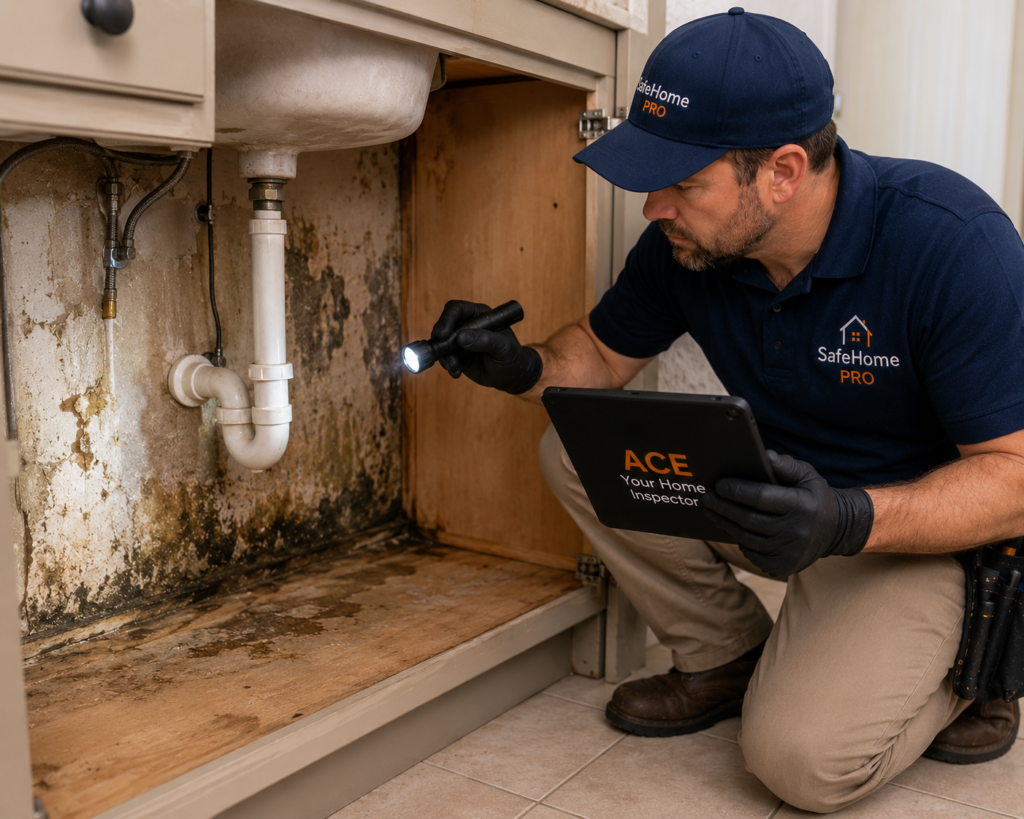
Plumbing problems usually announce themselves before they become emergencies — a drain that’s gradually slowing, a faucet that’s started to drip, a pipe that sweats in summer, water pressure that’s dropping off across the house, or a faint stain on a ceiling under a bathroom. The earlier the read, the cheaper the fix. This hub explains the most common patterns and where the line is for calling a plumber.
Common Patterns Homeowners Notice
Multiple drains slowing at once (often a main-line issue rather than individual fixtures), a single fixture that backs up regularly (usually a local clog or vent problem), a faucet drip that won’t stop with the standard washer fix, sweating cold-water pipes that drip onto framing, low pressure throughout the house, and unexplained stains on ceilings or walls below bathrooms or kitchens.
- Multiple drains slowing simultaneously — main-line story, not individual fixtures. Different fix than a single clogged sink.
- One fixture clogs repeatedly — local clog or a vent-stack issue. Plunger may help; persistent recurrence needs investigation.
- Faucet drip that won’t stop with a new washer — cartridge, valve seat, or supply-side issue. Often a 30-minute fix once diagnosed.
- Sweating cold-water pipes — humidity meets cold pipe surface. Insulate the pipe; address the room humidity.
- Low pressure across the whole house — likely a main shut-off, pressure regulator, or service-line issue (not a fixture problem).
- Unexplained ceiling stains below a bathroom — assume an active or recent leak until you’ve isolated it.
When Plumbing Becomes an Urgent Call
Any active leak you can’t shut off at a local valve is a same-day call to a licensed plumber — know where your home’s main water shut-off is before you need it. Sewer-gas smells, repeatedly clogged main drains, or visible water around a water heater base also belong on a same-day list. Slow drips and minor pressure changes can usually wait for a scheduled visit.
Three Shut-Offs Every Homeowner Should Know
- Main water shut-off — usually in the basement near where the supply enters the home. Test it once a year; older valves can seize closed.
- Water heater shut-off — the cold-water valve directly above the tank. Critical if the tank starts leaking.
- Fixture-level shut-offs — under each sink, behind each toilet. Test them when you first move in; many are seized from disuse.
Plumbing Guides — In Development
Detailed walk-throughs for the patterns below are in the build queue. Until they’re live, the DIY home inspection checklist includes the plumbing walk-through, and you can describe what you’re seeing to ACE for plain-language guidance on what the pattern usually means.
How to tell a local clog from a main-line problem, and the homeowner sequence that catches both before they back up.
Guide in developmentThe quiet signs of a slow leak behind a wall, under a floor, or above a ceiling — and how to confirm without opening anything.
Guide in developmentWhen low pressure is a fixture problem, when it’s a whole-house valve or pressure-regulator issue, and what to check first.
Guide in developmentWhy summer humidity makes pipes drip onto framing — and the simple insulation fix that solves most cases.
Guide in developmentNot Sure Whether It Can Wait?
Describe the plumbing pattern to ACE. You’ll get a plain-language read on what it usually indicates, what’s safe to check yourself, and when to stop and call.
Start With ACE ›